
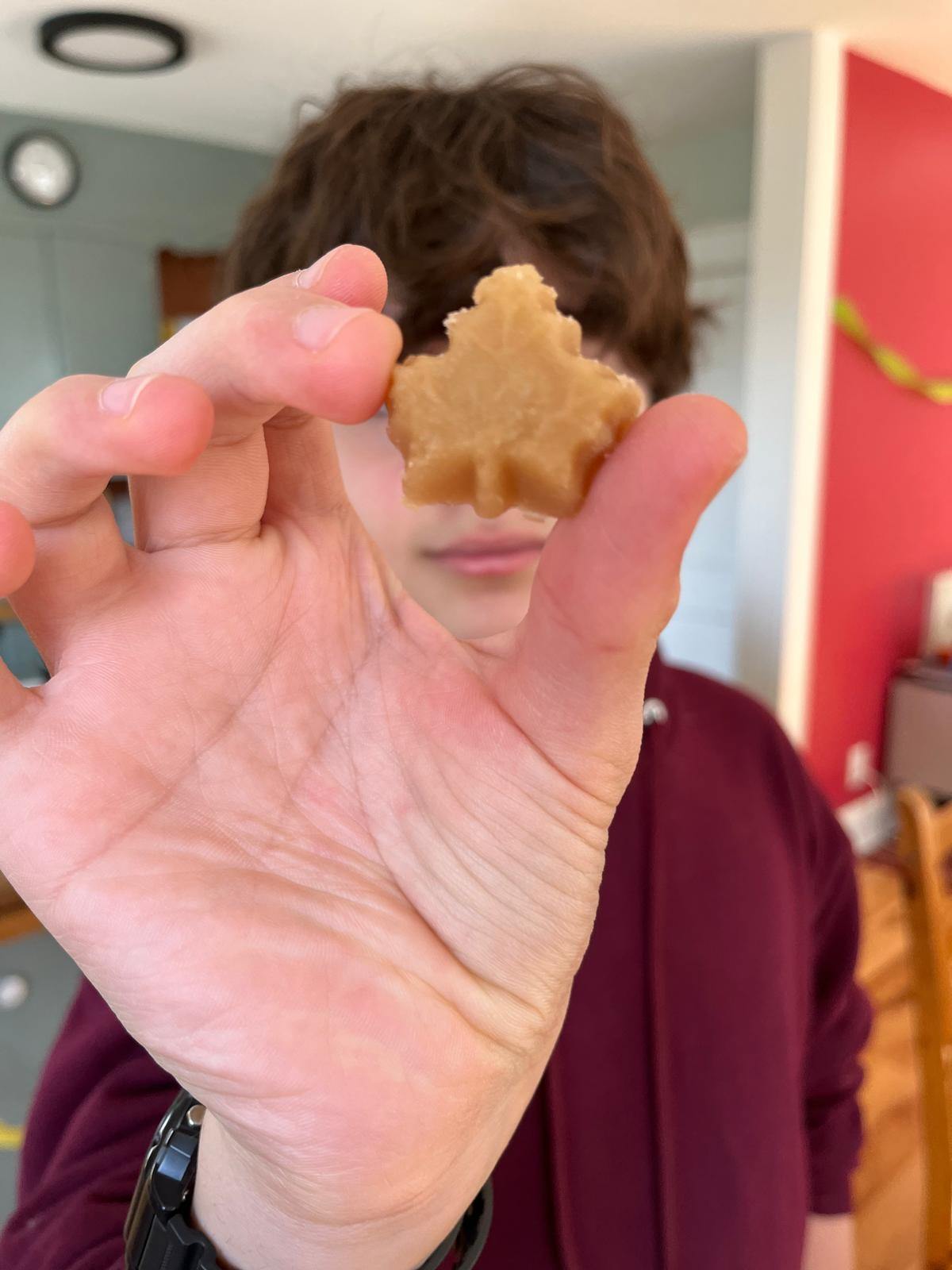
Join us in observing Native American Heritage Month this year by giving thanks for maple!
November is National Native American Heritage Month
We didn’t realize until we had been running this company for a few years that November was National Native American Heritage Month. We run a business manufacturing equipment for backyard maple sugar makers. Naturally, now that we are in-the-know, we feel inspired to give annual thanks for how open-air sugar making got its start many hundreds (thousands!) of years ago here among the native peoples of North America.
In past years, Vermont Evaporator Company has supported a tribe’s struggle to reestablish sovereignty over their ancestral lands, organizations helping indigenous communities emerge from COVID, and groups leading food and land justice and sovereignty efforts across the country.
Our Pledge
Last year, for the seventh year running, we pledged a portion of November’s sales to supporting Native American Land Use rights. As a result, we were able to give meaningful support to the Great Lakes Indian Fish & Wildlife Commission by defraying the cost of new sugaring equipment for indigenous maple syrup production on ceded Ojibwe lands.
The Great Lakes Indian Fish & Wildlife Commission is an intertribal natural resources management agency that includes 11 member bands. GLIFWC’s staff of 80, in coordination with tribal representatives, advocate for Ojibwe treaty rights and natural resources stewardship, acting on behalf of present and future generations.
GLIFWC includes Ojibwe bands that were signatory to the 1836, 1837, 1842, and 1854 Treaties, covering portions of the future states of Michigan, Wisconsin, and Minnesota. The collective region is known as the Ceded Territory.
Through negotiations in the mid-1800s, Ojibwe signatories in the Ceded Territory reserved their ability to live a traditional life on their homelands in perpetuity. Treaties with the United States detail boundaries, harvest activities (hunting, fishing, gathering,) federal trust responsibilities, and outline terms that recognize the Bands’ inherent right to self-govern and regulate off-reservation harvests.
Treaties are living documents; treaty rights are exercised mutually, and their protection is an important part of respecting the ongoing nation-to-nation relationship tribes have with the United States.
It is our belief that those of us who make our living in the maple industry should lend a hand to native peoples, like those supported by GLIFWC, who could use our support to achieve the kind of cultural and economic security we have achieved through maple. So we’re repeating our pledge: 5% of our November sales will support Native American land use rights again this year, and we’re happy to announce that we’ve choosen GLIFWC again as our eighth annual recipient.
“Supporting Ojibwe tribal lifeways is a core function of our agency,” says James Thannum, director of planning and development at GLIFWC. “Miigwech [thank you] to Vermont Evaporator Company for your valuable contribution in helping to not only maintain maple sap production capacity for Great Lakes Ojibwe tribes, but in assisting our work in strengthening community connections to traditional gathering.”
How You Can Help
The more we can sell, the more we can give! If you’ve been thinking about purchasing a Vermont Evaporator Company Product for your backyard sugaring hobby, and feel as we do about Native American land use rights, make your purchase this month and join us in our efforts!
Our flagship Sapling Evaporators, along with an updated line of accessories, a newly redesigned line of hobby sugaring pans, and even new t-shirts and hats are available for sale and deliverable by Christmas. Every sale helps!
More on the Origins of Maple
Learning is good too!
Corn, beans, cotton, tobacco and maple are all crops first developed by the Americans. Unlike with the first four products, there were a handful of prominent European immigrants who purported to take credit for the discovery of maple syrup or maple sugar (we’ll call out a certain Jesuit Priest, P.F.X. Charlevoix, on the latter). However, history and common sense weigh heavily against these lonely historical voices. Rather, European writings overwhelmingly describe the processing of maple as a traditional activity engaged in by tribes covering a vast geography of present day United States and Canada, with the language, customs and legends you might expect to attend to any practice of cultural importance.
Contemporaneous European writings indicate that maple sugar making was an activity widely engaged in across the continent among tribes that lived—at least at the time Europeans made landfall—across and even slightly beyond present-day sugar country. To appreciate this geographical scope, note the traditional territories of the Abenaki, Algonquin, Chippewa, Cree, Housatunnuk, Iowa, Iroquois, Kansa, Kickapoo, Menomini, Ojibwe, Omaha, Osage, Ponka, Tuscarora and Winnebago peoples—all of which are among those mentioned in European writings about maple—on this awesome map.
Native American words for maple are interesting too. Algonquins call maple sugar sinzibuckwud (drawn from wood), while the Tuscarora, Omaha/Ponka words for sugar – urenakri and janija – mean, simply “tree sap” (likewise, the Winnebago tanijura niju means “wood water” or “wood rain”). Like present day sugar makers, the Americans appreciated the difference between a maple tree generally—ninautik (Ojibwe for “our own tree”)—and the sugar maple, sheesheegummawis (Ojibwe for “sap flows fast”) too.
Far from being decried as “the cruelest month(s),” however, many Americans celebrated March or March and April as the “sugar moon,” and European accounts of the ceremony, dance, feasting and revelry that attended what we now call “sap season,” “boil-off season,” or “maple syrup time” abound. (This, perhaps, should come as no surprise, as at least one European immigrant noted that maple sugar sometimes functioned as a stopgap against famine here in the early spring months.) According to European writings, an Ojibwe custom involved a tribal leader mixing together maple sugar from the prior year’s harvest with the first grains produced in the present year to kickoff an annual feast, for example. And several tribes recounted to Europeans legends explaining the origins of maple—one as the unintended consequence of cooking with sap instead of water in order to save an arduous trip to the river, and another involving a divine being watering down what used to flow out of the tree as syrup as an instruction in proper work ethic (or rebuke for the lack of same).
The way the Americans made maple sugar, however, will sound quite familiar to the backyard sugar makers of today. As was common among the descendants of European (and other) immigrants up until just half-a-century ago, Americans typically set-out to live in a camp nearer to the family’s sugar stand when the sap began to flow. In a number of traditions, the camps belonged to the women and were passed down matrilineally. Unlike today, where practices vary, it was predominately the women of the family who ran the sugaring show, with the aid of children and youth (and, less often, or for specific tasks, grown men). They made bark sap buckets, bark buckets for transportation and storage of sap, “tapped” the tree with a gash and a wooden chip, and oversaw the boiling itself, which, until Europeans brought and traded metal cookware, took place in hollowed out logs into which were placed hot rocks. Like we do today, the Americans were known to throw the ice off of the top of a sap or sap-storage bucket to concentrate the sugars (it is officially not cheating!), and even store sap in large shallow pans to produce more ice (nature’s reverse osmosis!) to drink the sap, eat fresh syrup and maple toffee (present day “sugar on snow”) during the boil, and make gifts of their maple bounty (typically by pouring almost-sugar into carved wooden molds of animals, birds, people, celestial bodies and more)!
Because of the non-existence (or, after European arrival, scarcity) of glass and metal, however, the bulk of the American maple crop was made all the way into sugar and packed into bark baskets for transportation and year-round storage. This was done, as it is today, by continuing to boil past the sugar and toffee stages, and by stirring constantly until crystallization occurred. (Apparently, the Americans’ maple sugar lumps, like mine, sometimes needed a good whacking in order to resemble sugar. Which is also nice to hear.)
Americans ate maple products on their own (see above) but also relied upon it, in the same way Europeans relied on salt, to season their food. By way of example, European immigrants recorded eating corn porridge sweetened with maple sugar, rice, nut and fruit dishes seasoned with maple sugar, and dipping sauces made from maple sugar and bear fat on dry or cooked venison. American mothers were said to give their children small baskets containing sugar from the year’s first sap run, and lumps of sugar throughout the year when quiet behavior was unattainable using other methods. (Thus vindicating many a modern-day parenting style!)
There’s much more, of course, than what I’ve related here. If you are interested, pick up this book as a start. Enjoy the season, travel safe and enjoy your loved ones this Thanksgiving. And maple!
– Kate & Nikki
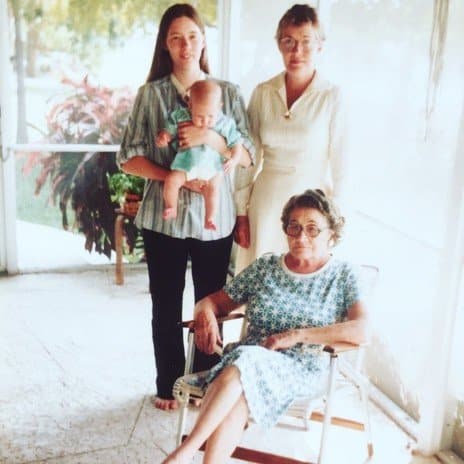
Kate’s heritage is also North American! She is pictured here with her matriline, which traces back to the Mi’kmaq, a native people of Nova Scotia, New Brunswick, Quebec, Newfoundland and Maine. The Mi’kmaq word for the month of March translates to “Maple Sugar Moon.” Kate has long since lost ties to this branch of the family, but we think you could still say she’s got maple syrup in the blood!