

A number of years ago, we acquired a very interesting customer: Cooper’s Daughter Spirits, a distillery and cooperage in Claverack, New York. Cooper’s Daughter purchased a Sapling Evaporator and used it for several years to make the black walnut syrup that forms the basis of their Black Walnut Bourbon. They have since grown their operation and upgraded to a larger, “indoor” evaporator. But we thought it worth catching up with them to educate the rest of our customer base about how to make black walnut syrup and how it differs from making maple syrup. Owner and Chief Operating Officer Rory Tice was kind enough to give us an hour of his time to lay it all out. Here’s what he had to say!
Making Black Walnut Syrup Is a Lot Like Making Maple Syrup
According to Rory, you make black walnut syrup using the same general process as making maple syrup: you tap a hole in a tree, you collect the sap, and you boil it down to syrup. You also use the same equipment (there is no black-walnut specific equipment.) Within that general process what techniques you use depends on what black walnut sugar maker you talk to. Sound familiar? Rory knows this because he talks to many black walnut sugar makers when he needs to supplement his own syrup production for the needs of the distillery. What follows is an explanation of how Cooper’s Daughter makes black walnut syrup on site, along with some notes about how others may differ.
Rory taps Cooper’s Daughter’s black walnut trees at the same time that maple tree sap is running in his area. While some black walnut syrup makers say they can collect sap from their walnuts after the maples stop running, this has not been Rory’s experience.
Rory taps with 5/16″ taps run to a 5/16″ dropline and 3/16″ lateral line in order to take advantage of natural vacuum. While he has not had luck with vacuum systems, Rory attributes that to “user error” and not to the trees. Rory uses the natural slope to gravity feed his sap tanks. Rory reports that while some black walnut syrup makers say that a 7/16″ tap will get you more sap, that, in his experience, there is no significant difference in yield between the two sizes.

Owner & Head Distiller, Rory Tice
Black Walnut Trees are Less Productive than Maples
While the general process is the same, there are some things about making black walnut syrup that are distinctly different from making maple syrup. First of all, while the ratio of sap to syrup is not unlike maple—Rory says he has measured from 35:1 to 50:1, depending on the year—a black walnut tree gives much less sap than a maple tree, so you have to plan on a smaller yield. Rory’s black maple trees produce only 15%-25% of the sap that a maple would. So, Cooper’s Daughter makes about 25 gallons annually from about 500 taps. In contrast, a professional sugar maker would figure on making 250 gallons of maple syrup from a 500 tap stand in a good year.
Black Walnut Sap Contains Pectin
The second big difference is that, like when making apple cider syrup from apple cider, the pectin in black walnut sap requires some procedural modifications. Instead of filtering once or twice, as in maple production, Rory filters about four times—once before boiling (1, 5 or 10 micron, as possible), once when the batch is half-way to syrup (5, 10 or 25 micron), once just before it is of syrup consistency (same), and again after the batch is done (25 micron). That ensures that the final product has a high-quality consistency and clarity. Unlike with apple cider syrup, however, if you overcook your black walnut sap, you don’t get jelly, you get burnt pans, messes and heartache, just like with maple. We figure there must be more pectin in apple cider than there is in black walnut syrup. A topic for another day, perhaps!
You may be wondering about whether reverse osmosis could help get rid of the pectin in black walnut sap. At this point, so were we! Rory does not use reverse osmosis in his black walnut operation, but knows people who do. Those folks say the pectin really clogs up the reverse osmosis filters. But does it make boiling filter-free as with maple? We don’t know.

A homemade barrel evaporator and a Sapling Evaporator boiling down black walnut sap
Black Walnut Boils Hotter
Rory reports that if he were to pour off black walnut syrup at 219 degrees Fahrenheit, like maple syrup, it would be a bit thin. He finishes his black walnut syrup at 221 degrees Fahrenheit. While neither he nor we are experts in the field, this could be because black walnut sap has a different caramelization point, a different mix of vitamins and minerals than maple (especially after all of that filtering) or something else entirely! We’re not sure anyone even knows!
The Taste of Black Walnut Syrup is More Variable
If you’ve never tried black walnut syrup, you should! Depending on the producer, black walnut syrup can taste nutty, of sweet vanilla, buttery, caramel, of toffee, or of toasted toffee. Black walnut can also have astringent notes that are bitter, sour or tannin-like. We have tasted Rory’s black walnut syrup and it is both excellent and the only syrup, in our opinion, that rivals maple for complexity!
The final big difference between maple syrup and black walnut syrup may be the variability of tastes in the final product. As maple syrup makers know, besides the level of caramelization that is required with saps of varying sugar content, there isn’t much difference between the taste of syrup made from sugar maples and syrup made from red maples or a mix of both. But, according to Rory, there is a huge taste difference between syrups made from saps of different members of the walnut family, trees of different ages, and trees from different places. For example, syrup made from the butternut (a.k.a. “white walnut”) will have a buttery taste that doesn’t appear in black walnut syrup. Syrups from “green” trees will produce a syrup that tastes as if it has more tannin in it. And syrups made from different regions taste differently as well.
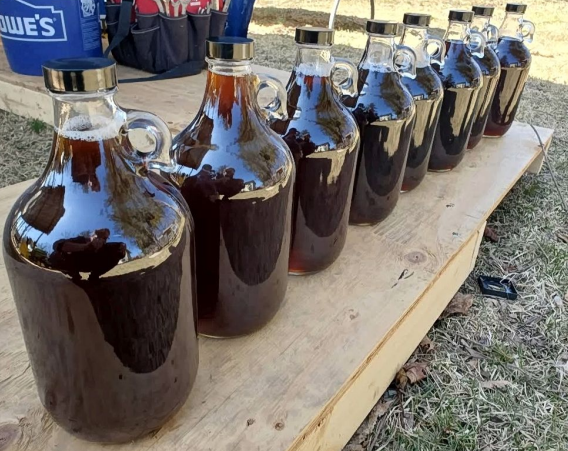
Jugs of black walnut syrup ready to be distilled
Black Walnut Syrup is Super Expensive
As you know if you’ve now perused the internet, black walnut syrup ain’t cheap! Bulk prices for black walnut syrup are upwards of $320 per gallon, whereas you can spend as much as $10 per ounce online. Perhaps that’s why the industry is growing! According to Rory, there are not even 100 professional black walnut producers in the country yet, and probably hundreds or even thousands of hobbyists.
Other Notes for the Black Walnut Hobbyist
Rory suggests that before you get into the hobby of making black walnut syrup, you consider whether tapping your walnuts will reduce their timber value. While tap wood is considered of especially high value for maple, no such tradition exists in the world of black walnut board foot procurement (yet). In addition, we’d both like to remind you that hobbies are supposed to be fun, and that your first (or second, or third) batch of syrup doesn’t have to be perfect to be good.
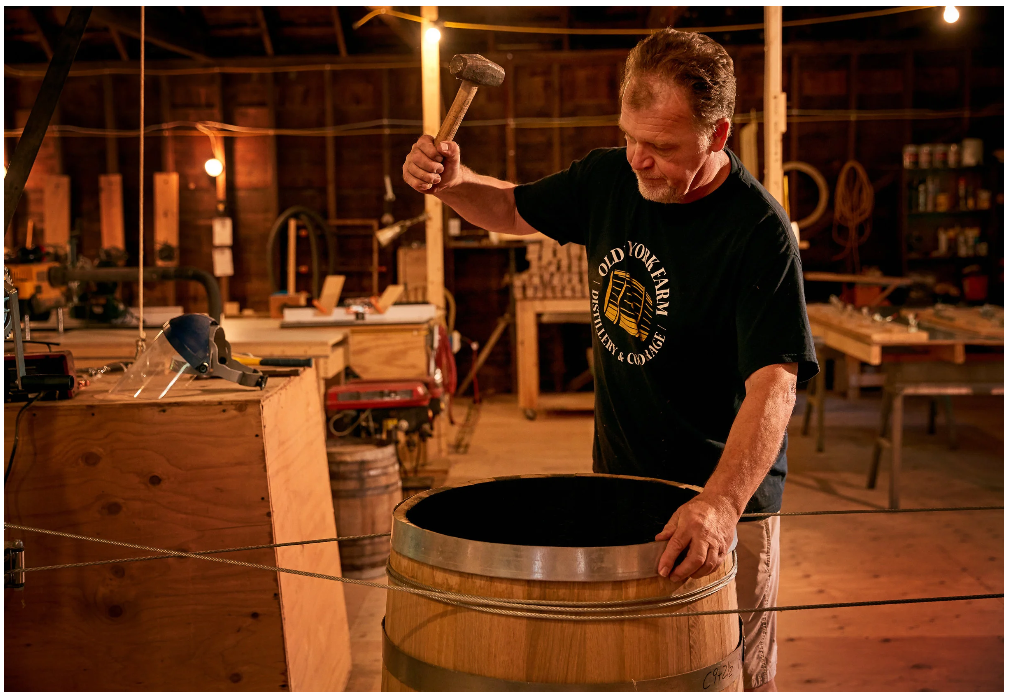
Owner & Cooper, Stuart Newsome; Photo Credit: Carl Stoneland
More About Cooper’s Daughter
Cooper’s Daughter Spirits is a woman-owned and family-operated distillery, cooperage, and apple orchard. The distillery and cooperage are located in a former carriage house along the Claverack Creek- 10 minutes from the city of Hudson. Local grain, fruit, botanicals, and tree syrups are the foundation for this distillery’s seasonal batch spirits. Barrels are handmade on site and are used to age bourbon and whiskey. On weekends, the distillery is open for drinks and food truck pop ups in the Cocktail Garden. Cooper’s Daughter ships their spirits nationwide. Looking for a destination or a unique gift? Check them out today at www.coopersdaughter.com!
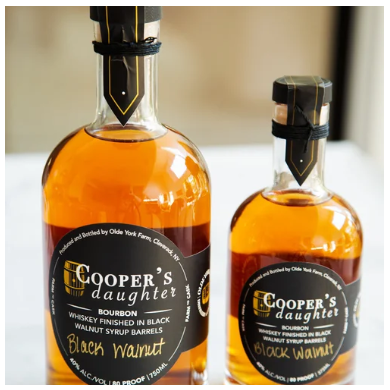
The finished product: Black Walnut Bourbon